

As a late bloomer, I hadn’t heard about Marie Kondo, the KonMari method, or her books until 2020 (9 years after her bestseller was first published). And, again, I did not read the book at first, but got obsessed with her Netflix show Tidying Up with Marie Kondo.
If you are not familiar with neither, let me summarize briefly what is she all about. Marie Kondo was born on 9 October 1984 in Japan. As a child she had the most extraordinary hobby – tidying up. She says that her world-renowned method came to her after a nervous breakdown and as a voice from above:
“When I came to, I heard a mysterious voice, like some god of tidying telling me to look at my things more closely. And I realized my mistake: I was only looking for things to throw out. What I should be doing is finding the things I want to keep. Identifying the things that make you happy: that is the work of tidying.”
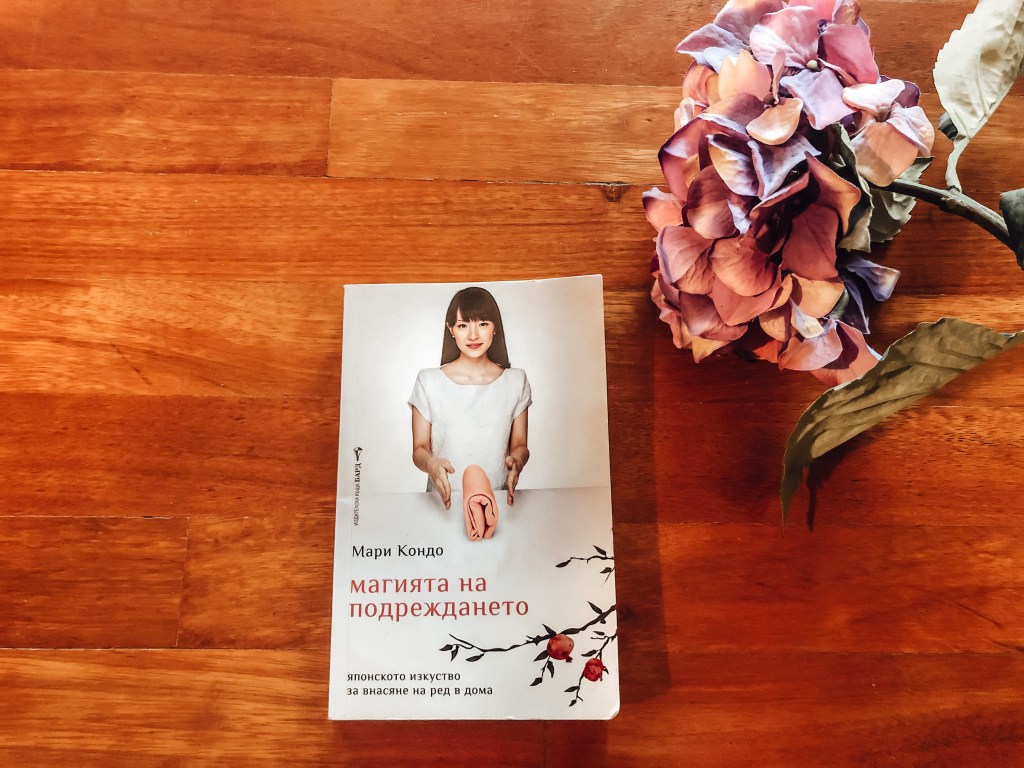
Whatever that entity was, it set her on the quick road to success. Her book The Life-Changing Magic of Tidying Up has been published in more than 30 countries and has become a bestseller around the globe. Even me, a firm believer in living a messy life, find her method quite interesting.
Her philosophy is really simple:
- Keep in your life just the things that spark joy;
- Do not start to organize by room, but by category;
- Hold every item in your hands and see if it makes you happy. If not, politely say thank you, and throw it out;
- Declutter everything at once – tidying up tiny bits will lead to having to tidy something every day of your life.
Let me make myself clear. I totally hate cleaning. I tend to throw my clothes around the room and leave them there for weeks. I do not like throwing stuff out. I’d started watching the show just because there seemed to be nothing else worth my time that I haven’t watched already during quarantine. And I got obsessed. Seeing this cute, little lady explaining her perfectly reasonable-sounding method to hoarders like me, was kind of eye-opening: I should do something before my own possessions take over and suffocate me.
So I decided to buy her book as quickly as possible and tackle the categories one by one. The KonMari method identifies five areas, on which to concentrate your efforts and it is important to keep the order the same:
- Clothes;
- Books;
- Papers;
- Komono – all miscellaneous items from kitchen, bathroom, garage, etc.;
- Sentimental items.
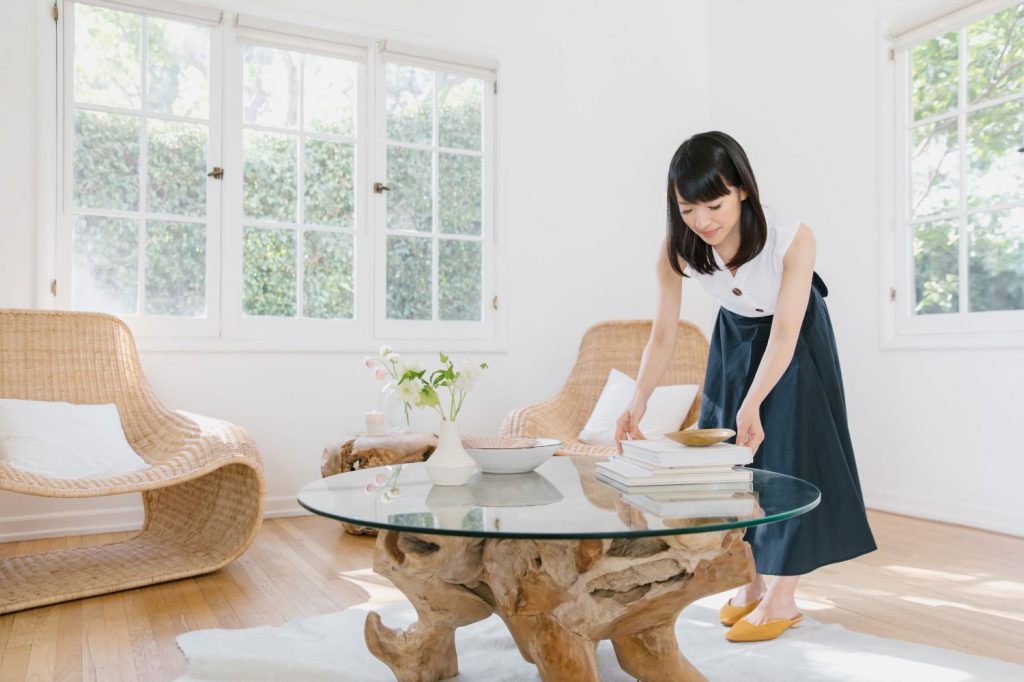
Her idea is to take every single item that you own from the same category, put it in the middle of the room, and check what sparks joy and what does not. The point is to get rid of everything at once, one big tidying adventure to put a stop to the mess forever. And it is strongly recommended not to try and adjust the method to yourself but follow it to a T. Sounds simple, doesn’t it? Especially when you see all those couples crying from joy at the end of each episode of her show. They somehow managed to overcome their reluctance to throw out stuff.
Well, it is not that easy at all! I had started the process with what was the first thing she is suggesting in the book: my precious, overcrowded wardrobe.
Have you heard a lady saying “I have nothing to wear?” Oh, I do it all the time! Although I own a four-wing wardrobe, full to the point of a near explosion. I have old clothes that do not fit anymore, new outfits with the tags still on, that I have decided I don’t like, sentimental pieces, that I just cannnot bring myself to throw out. So the mere idea to be done with all of this for good, seemed to me as the light in the end of a tunnel.
The day I had chosen came and I gathered ALL my clothes, old and new, on the floor in the middle of my room. I started with the pieces that were obviously beyond repair, happily thanked them as instructed, and threw them in the garbage. Now, with that done, I passed on to the rest of the pile. It was easy to identify the three items I actually liked and I remember thinking: “This must be working, right?”

Unfortunately, no. I soon came to discover that I do not know how I feel about half of the pieces in my wardrobe. I did not like some of them, but they were still with tags on and it seemed completely wasteful to throw them out. Others were old and with stains but with huge sentimental charge. My energy quickly fell down. I looked around my room, floor still half-way covered in clothes that I simply cannot decide what to do with, and I almost started crying. I had failed Marie Kondo. And most importantly, I have failed myself!
The clothes stayed on top of the furniture for a few days. I came to a point where it was time to decide what to do with them since there was no space in my own room even to sit. And I came to the conclusion: It is my house, I will follow my own rules!
There were so many stuff from the KonMari method I liked! But there was also the downfall of purging your belongings. So I decided that I will take from it just what I like and make a new method. I separated the remaining clothes into my own categories: *Will Never Wear* with separate piles for throwing out, donating and selling (will tell you about that in a second), and *Will Probably Wear* with my go-to outfits, some that I like, but do not fit anymore, and some I was not completely sure about, but thought I may regret throwing.
The clothes that went to the garbage that day were really old and tattered and I did not think anyone would have wanted them. Keep in mind that in stores like H&M there are containers where you can dispose of clothing in order to get recycled. This is not only good for the environment, but also you get some store credit for your next purchase. The rest of the *Will Never Wear* pile went to charity or got sold. I discovered that there is a really strong market for old clothing, especially for some of my party dresses that I haven’t worn in years. I set up accounts on two or three different platforms (the ones to go to in Bulgaria are OLX and Bazar) and took some pictures of my dresses. A good advice, if you decide to sell, is to describe the item really well and also to mention all imperfections. In this way, you are reducing the risk of unhappy buyers and returned shipments. I gave myself three months to sell everything, put the clothes in vacuum bags and stored them on a shelf. The only thing left to do was wait. For my surprise almost 70% of the stuff I have chosen to sell found themselves a new owner. The rest went to charity.
The clothes that did not fit, but I still thought might some day, I had also put in vacuum bags with a note to myself if they are still not fitting by this time next year to either sell or donate them. The rest, I hanged in the now much emptier wardrobe. Looking back, I am happy I did not throw out some of the clothes that did not spark joy. For example, this winter I rediscovered a skirt I have not worn in 8 years and made it a staple piece for my outfits.

I applied the way that Marie suggests to use in organizing your wardrobe. It is definitely easier to find a t-shirt when it is vertically folded and put in a shoe box. I also liked the idea that the clothes should be hanged with the lighter and shorter ones to the right. According to her, coats should be to the left, followed by dresses, suit jackets, pants, skirts, and then blouses. She teaches to respect even your socks and suggests to put away the seasonal clothing in order to make space for what is relevant at the moment.
With the books, I again did my own thing and sold whatever I did not need anymore. Another good idea here is to donate them to a library or participate in a Facebook group, where you can exchange them for something that is interesting for you at the moment.
The rest of the categories did not present such a problem for me. I did not mind to dispose old papers that I would never again need. Or a key chain given to me as an advertisement. I have to confess, though, that I still hold on to a box of old tickets and brochures from my trips, but they occupy only a small box that lives under the bed. I find the plastic storage containers Marie proposes very useful and have a bunch of them around my house.
Although I do not agree with the idea that the KonMari method cannot be changed to fit your own personality, I find the book and show very useful for several reasons. First of all, since I’ve tried it, I feel like I am able to let go of unwanted items much easier than before. My room is not the mess it used to be and the space around me is less cluttered. I cherish more my clothes and organize them in efficient and comfortable way. The book and show have had an impact and had definitely changed me for the better!
P.S. If you want to check out Marie Kondo, her show Tidying Up with Marie Kondo is still available on Netflix. Also an interesting source of information is her website , and, of course, her book The Life-Changing Magic of Tidying Up.
Let me know in the comments what do you think of the KonMari method and I will see you in the next article 🙂
Photos: Personal archive and https://konmari.com/
 Confusion in Wonderland