

It is undeniable: Barcelona is one of the Old Continent`s most impressive cities that can put to shame even some of the European capitals. Most famous for its stunning architecture, the city would not be what it is today without the creations of the talented architect Antoni Gaudi. During my two visits to Barna (the nickname given to the city by the locals), the houses that Gaudi designed took my breath away. And that is without even mentioning the most stunning building I`ve seen in my life – La Sagrada Familia.
Who is Antoni Gaudi?
If you`ve ever been to Barcelona, there is no way not to know who Gaudi is. La Sagrada Familia, Park Guell, and La Pedrera are probably the most iconic landmarks in the city. But who was the person behind the famous architect?
Antoni Gaudi was born on 25 June 1852 in Reus or Riudoms (his exact birth place is unknown) as the youngest of five children. In his early years, he suffered from poor health and often spent long periods of time observing nature which later he will call “the supreme work of the Creator”.
At the age of 18, he moved to Barcelona in order to study architecture. Although an inconsistent student, he showed undeniable promise and was allowed to work alongside some of his professors. On his graduation day, the Director of the School of Architecture will make the famous statement:
“I do not know if we have awarded this degree to a madman or to a genius; only time will tell.“
And he was right – time proved that Antoni Gaudi was a genius.
The architect was at the forefront of the Art Nouveau movement, known as Modernism in Catalunya. He was famous for favoring the trencadis technic of mosaic art, which uses irregular pieces of ceramic, glass and marble tiles. Gaudi accepted one master only: Nature. Most of his creations were inspired by it and led by the principal “originality consists of going back to the origins”.
During my first visit of Barcelona and before I knew who Gaudi was, I was surprised and intrigued by the story of his death, that I learned during a free walking tour. In his late years the architect had abandoned the vanity of his youth and was living a simpler life. He neglected his appearance and devoted himself even more to religious and mystical sentiments.
One day, while walking towards his favorite church in the city center, Gaudi was hit by a tram. Nobody suspected that this disheveled old man, who was carrying no papers, was Barcelona`s most adored architect. He was identified three days later, when a priest from Sagrada Familia came to the hospital to give him Last Communion. Gaudi died on 10 June 1926 at the age of 73. He was berried two days later in the crowning jewel of his work: La Sagrada Familia.
Gaudi Creations You Should Visit
Here is a list of my favorite must-see Gaudi locations in Barcelona:
1. Casa Vicens

For prices and visiting hours, click here.
I did not visit Casa Vicens during my first time in Barcelona in 2017. That is why it was way up on my to do list this time around. As I had already seen Casa Mila and Casa Batllo, which are considered the crowning jewels of Gaudi`s work, I did not have very huge expectations. But this house ended up to be my favorite from the ones I’ve visited and would whole-heartedly recommend it.
Although, Casa Vicens is not situated on Paseo de Gracia, it is still located in the Gracia neighborhood. The beautiful building, adorned in red and green tiles, catches the eye from afar. It was build between 1883 and 1885 and is considered Gaudi`s first major work in Barcelona. It belongs to his orientalist period and truly makes you feel like you are on a journey into the Far East.
Amongst my favorite features are the terrace – a small oasis in the heart of Barcelona, and smoking room, which looks like as if has just came out of one of Scheherazade`s stories. It is impossible not to be impressed by the craftsmanship of the ornate dining room ceiling and walls, as well. For me, the whole house felt like a magical sanctuary in the middle of the busy city. The impression is fortified by the audio guide, which brings you back in time to the creation of Casa Vicens. Definitely worth a visit!
2. Palau Guell
For prices and visiting hours, click here.
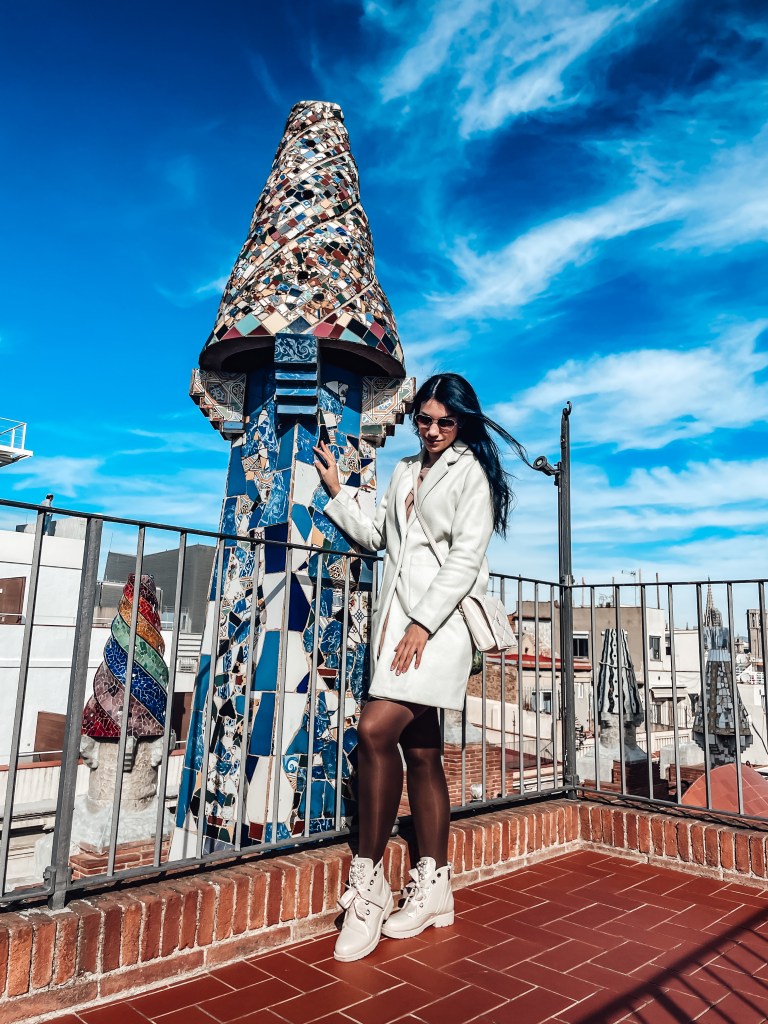
Far from the other houses, designed by Gaudi, Palau Guell is located on the touristic La Rambla street, a few blocks away from La Boqueria Market. It is the one building that I would not immediately recognize as a work of the famous architect. On the outside, the house is much more darker and grimmer than his other masterpieces and brings on Gothic vibes. It would not remind me of Gaudi at all if it weren`t for the imaginative chimneys, that are a bit hard to be seen from the street.
All that said, the interior of the place is absolutely worth a visit, as it brings light to some early Gaudi designs and ideas. Build between 1886 and 1890, the mansion was the home of the Guell i Lopez family until they moved to Park Guell. A UNESCO World Heritage Site, it is a functional space, adapted for both family and social life that laid the base for Gaudi`s future creations.
When visiting, do not miss the rooftop, which for me, is the most impressive part, with its colorful chimneys, so typical for the Gaudi aesthetic.
3. Casa Mila (La Pedrera)
For prices and visiting hours, click here.
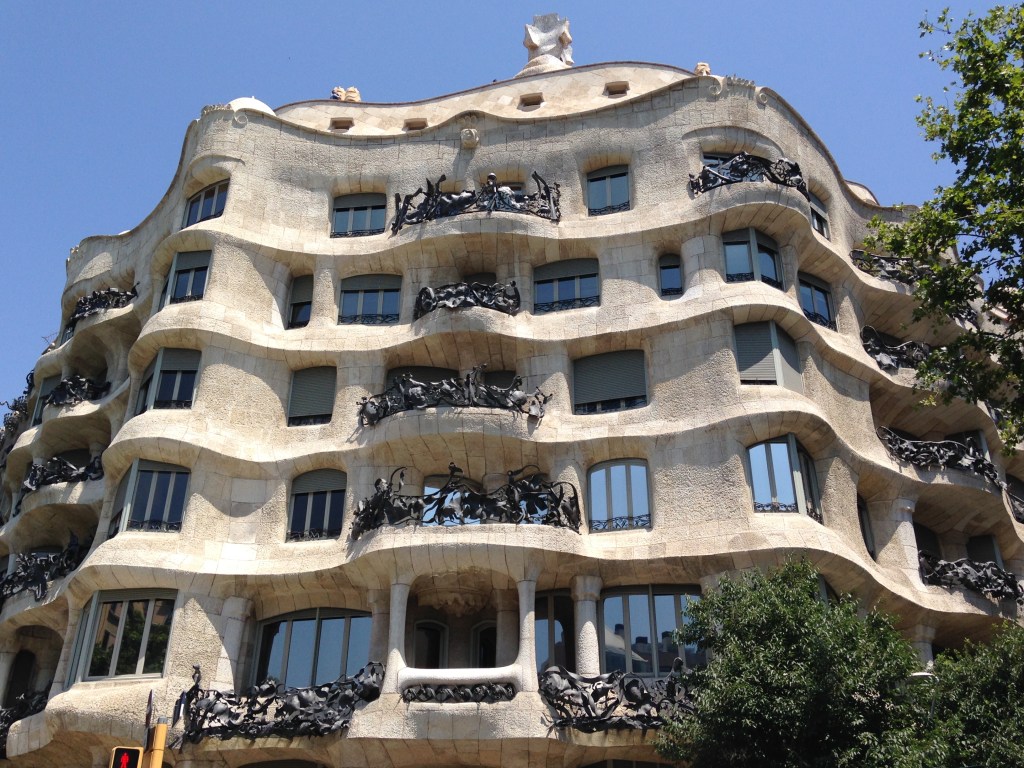
Casa Mila or La Pedrera (which means “the stone quarry”) is one of the most recommended landmarks to see in Barcelona. It is the last residential building, designed by Gaudi, and was build between 1906 and 1912. At the time, it was the first house on Paseo de Gracia with underground parking for carriages. Another interesting feature is that there is not even a single load-bearing wall in the entire place, only columns and open spaces. Nowadays, one part of the building is still used for housing and the other has been turned into a cultural centre.
Contrary to common opinion, this is my least favorite Gaudi work and the one I wouldn`t visit if I had limited time in Barcelona. Although the stark façade and the wrought iron banisters of the baloneys are impressive, they are definitely not my cup of tea. The one thing I was fond of is again the rooftop, which features sculptured chimneys and air vents, with both decorative and structural purposes. There is even a rumor that George Lucas took inspiration from them for the design of the helmets of the imperial soldiers in Star Wars.
4. Casa Batllo
For prices and visiting hours, click here.
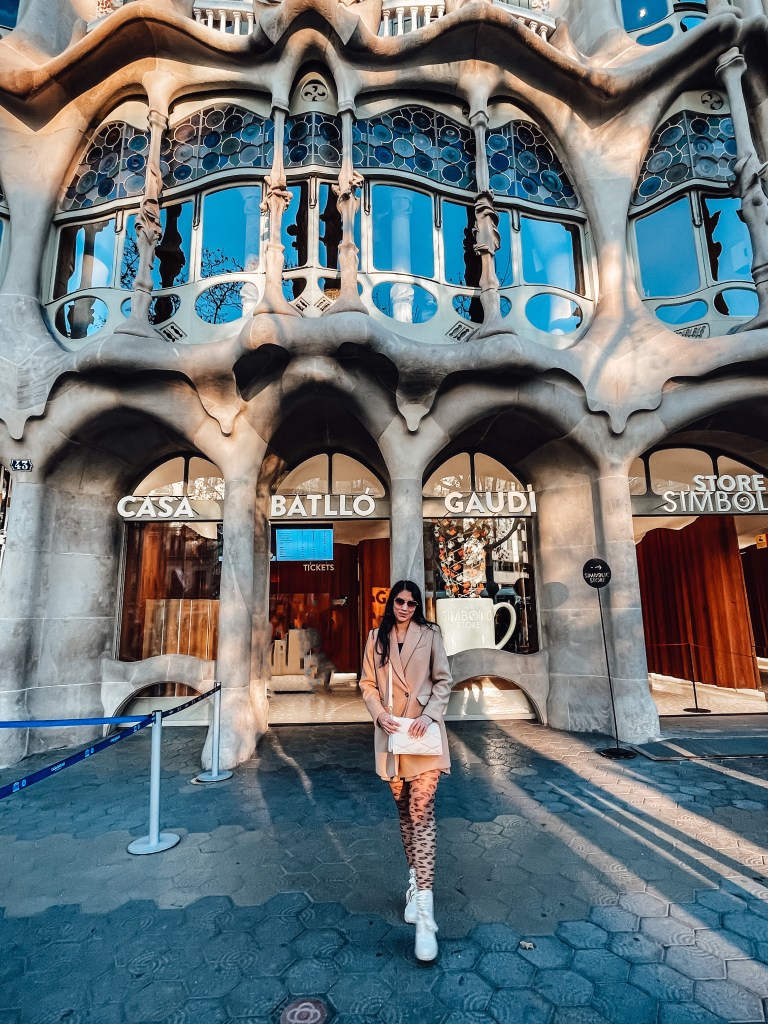
Alongside Camp Nou and La Sagrada Familia, Casa Batllo is one of the most expensive attractions in Barcelona. But is it worth a visit?
Well, I visited the house for the first time in 2017 and was really impressed. Back then, in the general admission price you received an augmented reality guide that made the place come alive in front of your eyes! It was like a glimpse into Gaudi`s mind – an interactive experience, compared to no other I had had that far in Barcelona.
The attraction reopened in 2021, after being closed for safety reasons during the pandemic. When we visited this February, it kind of has lost a part of its charm. The new entrance area is much smaller and the prices higher. I felt like some of the features I saw the previous time were gone and was unpleasantly surprised to learn that you can have the augmented reality guide, but only if you pay extra. But if I was a first-timer, I would have overlooked this downfalls and still went in. And probably paid for the augmented reality guide, as well.
5. Park Guell
For prices and visiting hours, click here.
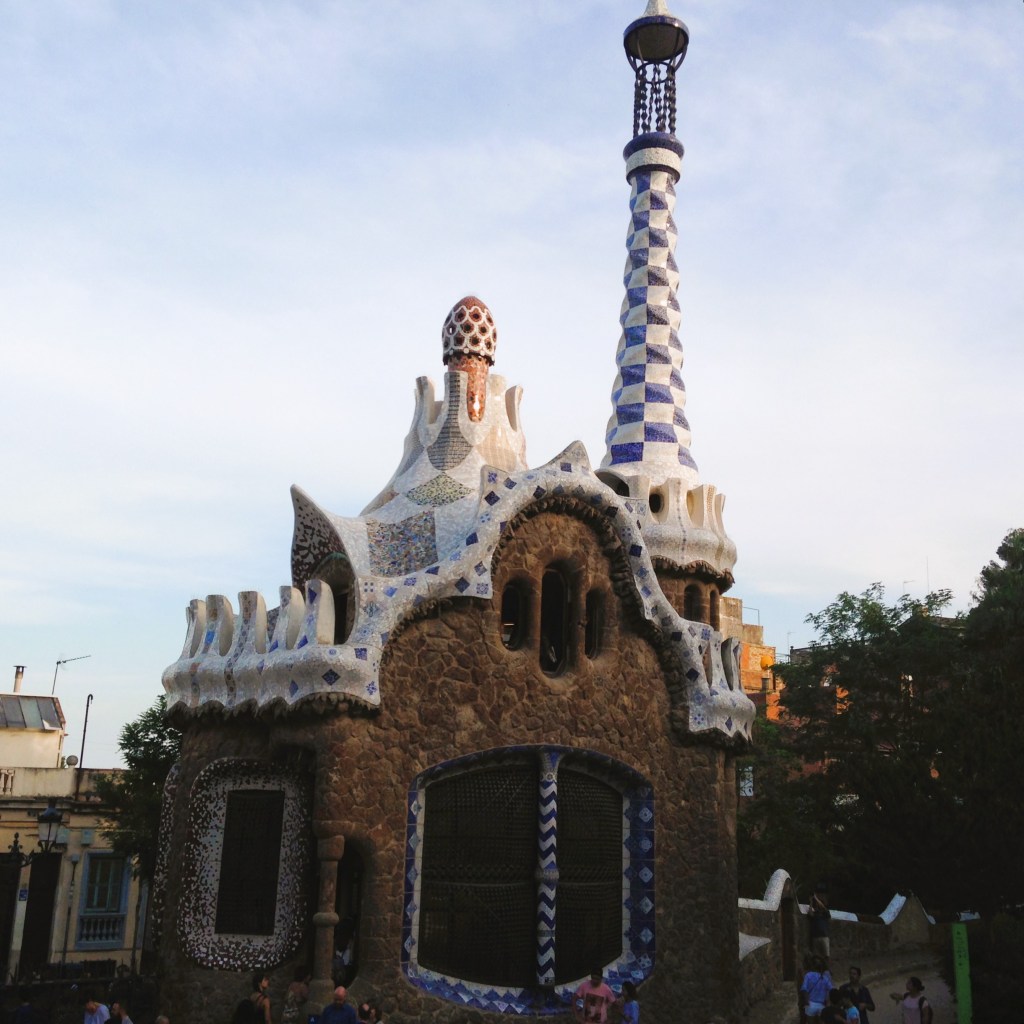
Did you know that Park Guell, one of Barcelona`s most famous attractions, was intended to be a residential area for the rich? The idea was 60 homes, that would take advantage of the fresh air and magnificent views from the site, to be build there. Unfortunately, the project was unsuccessful and only two houses were constructed on site. But the communal areas, that Gaudi designed for the neighbors that would have lived there, turned the park into the world famous monument it is today.
My recommendation is to book this attraction in advance, as in the summer period it is incredibly hard to find same day tickets. Also a good idea is to join a guided tour as this is the best way to learn everything about this remarkable place. I would avoid the warmest hours of the day for my visit as it tends to get quite hot there.
My favorite part of the park is the covered market, with its Doric columns and mosaic ceiling. Other points of interest are the Greek Theatre, the dragon fountain and the House of the Guard, which is now a museum dedicated to the park itself. So what are you waiting for? Get a map of the park and start exploring!
6. La Sagrada Familia
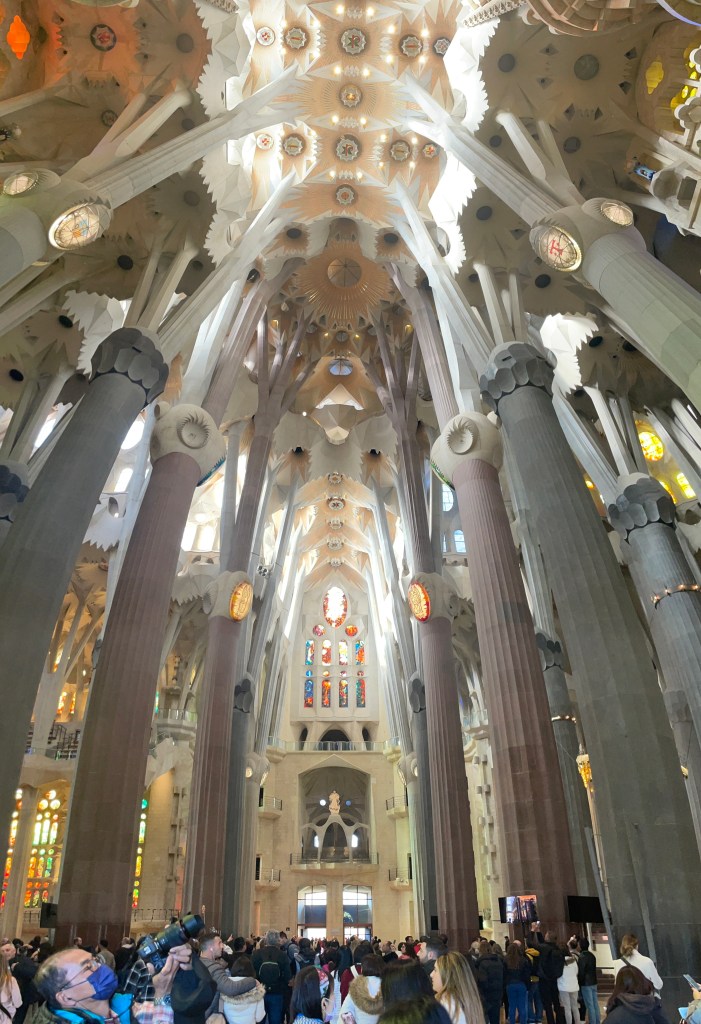
For prices and visiting hours, click here. For this one you should definitely book at least two weeks in advance!
Sagrada Familia. There is no other building like this in the entire world!
When I was a little girl, my mother, who is a Spanish teacher, visited Barcelona, for a conference. She brought back pictures of Gaudi`s masterpiece, and I just fell in love with this building, which to me looked like was made from molten sand. I knew one day, just one day, I would visit it and submerge myself in this magical place that combines religion, nature and the pure essence of humanity.
Gaudi himself was aware that the construction of the temple will last even past his lifetime and reflected on that:
“There is no reason to regret that I cannot finish the church. I will grow old but others will come after me. What must always be conserved is the spirit of the work, but its life has to depend on the generations it is handed down to and with whom it lives and is incarnated.”
Today, more than 135 years after the laying of the first stone, Sagrada Familia is not only the symbol of Barcelona, but also the largest unfinished building in the world. That does stop it to be one of the most impressive creations constructed by men. The exterior, as well as the interior, is definitely worth a visit and, although the ticket prices are probably the highest of any attraction in Spain, the money go towards the continuing construction of the church, which is a worthy cause.
If you, like me, are already in love with this masterpiece, you should come back in 2030 – the year, according to predictions, when the monumental work that Gaudi started, will be finished. And although I cannot imagine the church to become even more beautiful as it already is everything, I cannot wait to see it completed. Even if it is not 7 short years from now, let`s hope it would be in our lifetime.
So, Sagrada Familia, my lovely, I hope to see you again very, very soon!
Photos: Personal archive
 Confusion in Wonderland