

Human existence is made of moments connected with places and people. Some of those turn into memories, and a fraction of those memories we remember all our lives. Years passed since I’ve visited Chernobyl, but this eerie Ukrainian town is engraved in my brain. Maybe places like this – that are connected with immense human tragedy – are hard to erase. But one thing is sure – for me, Chernobyl will always be the most memorable city I’ve ever visited.
Important: If you want to read Chernobyl: A Trip into the Exclusion Zone Part 1, where you can check out Things to Know before You Go and Entering the Exclusion Zone, please click here.
The City of Chernobyl
We all have heard of it. The name “Chernobyl” has become a synonym of one of the biggest disasters in human history. But what have remained of the city, connected with so much grief, today?
The city of Chernobyl used to be the administrative center of the Chernobyl District from 1923 until 1988, when the district got dissolved. It was chosen to be the site of Ukraine’s first nuclear power plant in 1972. Its fate was sealed back then and 14 years later, on 26 April 1986, its name became forever associated with the nuclear disaster that brought down the Soviet Union.
You cannot mistake the moment when you are stepping into the city. Although exactly 35 years have passed from the incident, the grand communist sign, announcing you are now entering Chernobyl, is still up. For me, it represented perfectly the ideals of the lost Soviet era – bright sun over the construction of the new power plant, branded with the hammer and the sickle.
The time has not completely stopped here, though. This is due to the fact that people still live in Chernobyl, in houses marked with signs “Owner of this house lives here”. The city also currently contains the offices of the State Agency of Ukraine on the Exclusion Zone Management and some of the apartment blocks are transformed into accommodation for its employees. The time that each of them can spend in the Exclusion Zone is limited due to fear of radiation exposure. The city also features a hotel, supermarket, a museum and some newly built monuments of the disaster.
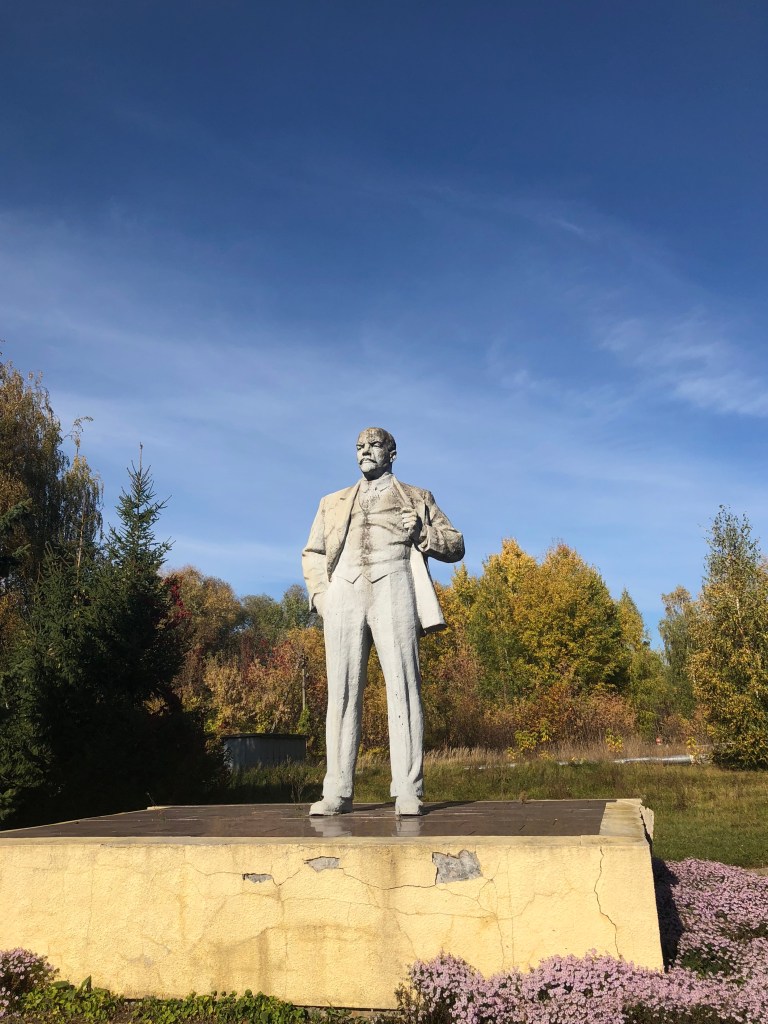
If you’ve recently been to Ukraine, you know that the country is trying to implement major decommunization, so the statues of Lenin are completely removed. Not in Chernobyl, though! It stands guard to ideas long lost and is one of the two still remaining intact in the whole country.
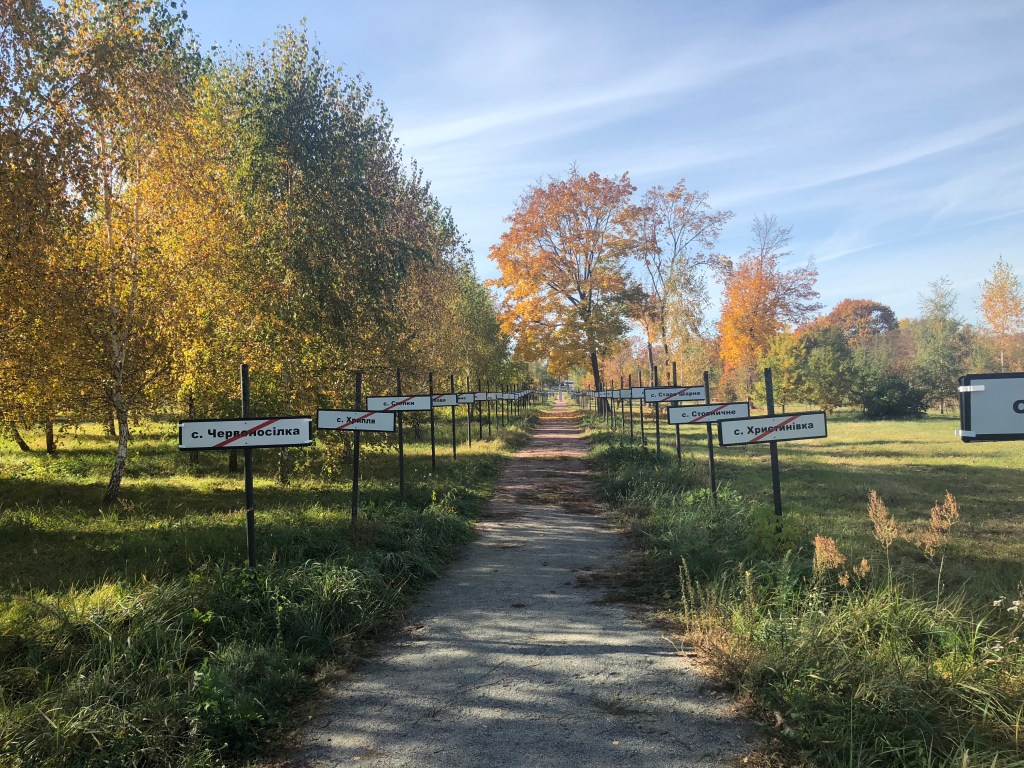
Another thing that struck a cord with me was the memorial “The Wormwood Star” ( Chernobyl translates to “wormwood” in English). It is dedicated to the villages that were evacuated after the tragedy and consists of the signs with the names for all 189. It was really emotional experience to walk amongst them as it makes you comprehend the tremendous scale of the disaster. An interesting fact that I learned and is connected with the monument is that many people actually believe that the nuclear disaster was predicted in the Bible:
“The third angel sounded his trumpet, and a great star, blazing like a torch, fell from the sky on a third of the rivers and on the springs of water – the name of the star is Wormwood. A third of the waters turned bitter, and many people died from the waters that had become bitter.”
Revelation 8:10-11
The Monument Of Those Who Saved The World is also located in Chernobyl. It is dedicated to all firefighters, who gave their lives putting out the fire on the fateful night of the accident, and the liquidators that cleaned up the radioactive debris.
The visit of the city finished with a lunch. This was not included in the price of the tour, but since it costed only 10 euros and seemed like an unique experience to have a meal in Chernobyl, I’d decided to try it. Unfortunately, I did not like any of the food, which consisted of a soup, a main dish and a small desert. My opinion should not in any way put you off trying it, as many other people from our group did like the meal. But if you are a picky eater, like me, better to withhold and bring food with you, which you are allowed to eat in covered places. Some people tried to eat the ice-cream, they got from the supermarket, outside and were severely scolded by our guide.
The Abandoned Soviet Daga-3 Radar

We all know now that the Soviet statesmen were secretive and hush-hush, but the next stop of our visit to the Exclusion Zone was a true reminder of that.
The Daga-3 Radar. On the Soviet maps this construction was marked as a children’s camp. On the way there, we were even shown a bus stop, decorated with the cute bear mascot of the 1980 Summer Olympics in Moscow. What more innocent than that, right?
The sight we witnessed when we arrived, however, did not seem innocent at all! The construction was seen over the tree tops and it looked like huge metal cylinders, attached to each other. To me, it seemed enormous, impending and super threatening. And it turned out to be what remained of one of the most powerful facilities in the Soviet Union.
The construction of the Daga-3 began in 1972. The 150 meters tall and 700 meters wide structure was supposed to recognize missile threats and prevent attacks. It was rumored to be able to detect a plane, taking off in the U.S. and the strange, woodpecker-like transitions that were heard from it on radios around the globe, were the reason for a lot of conspiracy theories about mind reading and weather control. There is also a theory that the Chernobyl nuclear disaster was connected with the radar.
Today, the structure still can make your head spin with its enormous proportions. It remains a sight to behold and is definitely a must-see for every visitor of the Zone.
At this point of the tour I could not imagine anything that was able to impress me more, but I did not know that the city of Pripyat and the Chernobyl Nuclear Power Plant are coming next…
Story continues here…
Photos: Personal Archive
 Confusion in Wonderland
[…] Part 2: The City of Chernobyl and The Abandoned Soviet Duga-3 Radar ( link here); […]
LikeLike
[…] Important: If you want to read Chernobyl: A Trip into the Exclusion Zone Part 1, where you can check out Things to Know before You Go and Entering the Exclusion Zone, please click here. If You want to read Chernobyl: A Trip into the Exclusion Zone Part 2, where you can check out The City of Chernobyl and The Abandoned Soviet Daga-3 Radar, please click here. […]
LikeLike