

Have you ever been to a place that haunts you even after you are long gone? Or one for which people exclaim: “Really? You’ve been there? I would never dare!”? I have. And wouldn’t exchange my eerie experience in the ghost city of Pripyat for any expensive resort vacation in the world!
Important: If you want to read Chernobyl: A Trip into the Exclusion Zone Part 1, where you can check out Things to Know before You Go and Entering the Exclusion Zone, please click here.
If You want to read Chernobyl: A Trip into the Exclusion Zone Part 2, where you can check out The City of Chernobyl and The Abandoned Soviet Daga-3 Radar, please click here.
The Chernobyl Nuclear Power Plant
The Vladimir Ilyich Lenin Nuclear Power Plant, or as it is known more widely – the Chernobyl Nuclear Power Plant, consisted of four RBMK-1000 reactors, with two more being in construction. In the early hours of 26 April 1986, following the unsuccessful attempt for a safety test, an accident occurred, causing an explosion in its 4th reactor. We all know what happened next – the biggest nuclear disaster in human history.
What is less widely know is the fact that 1st, 2nd and 3rd reactors of the plant continued to function years after the accident. The second one was shut down in 1991, after it caught fire and was deemed unsafe. In 1995, following negotiations with the European Union, Ukraine agreed to close down the remaining two reactors, in exchange for EU’s assistance in modernizing the existing concrete and lead sarcophagus, entombing Reactor 4. For me, it is astonishing to learn that Reactor 3 was operating until 2000!
I never even dreamt that it would be possible to see the reactors up close. Well, it is and it’s definitely a sight a person would not want to miss!

The next stop in our trip into the Exclusion Zone was the new Safe Confinement of Reactor 4. On the way there, we were able to see the construction sites of Reactors 5 and 6, that were never finished. We also learnt that a station for the disposal of radioactive waste is in the plans to be build near the Chernobyl Power Plant. But the most impressive thing we saw, was, without doubt, the Safe Confinement.
Its construction was just finished, when I visited the plant in October 2018. It was designed with the goal to prevent the release of radioactive contaminants, protect the reactor from external influence, and facilitate its disassembly and decommissioning. And the arch-shaped steel structure looked nothing but magnificent. It’s no wonder they say it is going to last for the next 100 years!
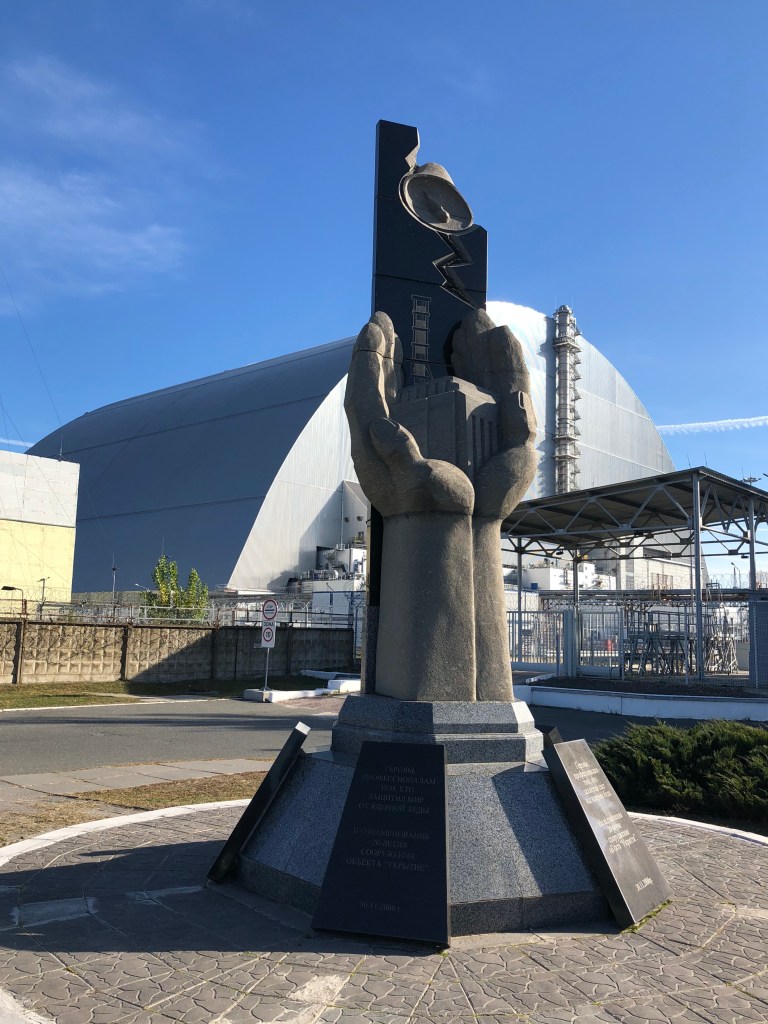
It is here, where the guides make a special stop in front of the Chernobyl Sarcophagus Memorial. It represents cupped hands holding a power plant and was constructed back in 2006 in remembrance of the heroic actions of plant workers and emergency crew who prevented what could have been a global disaster. This was really impressive and emotional spot and, for me, it was not surprising that it was chosen to be the last frame of the TV series “Chernobyl”.
Being so near the Sarcophagus undoubtedly felt like being a part of history itself. The emotion of standing in front of it was very different than seeing it on TV. It certainly felt like a privilege.
The City of Pripyat
However interesting the New Safe Confinement was, we still had to see the crown jewel of our tour – the city of Pripyat.

On the way there, though, there is still one sight worth mentioning – the buried village of Kopachi. After the disaster the little village was completely torn down and buried as an experiment. What you can see today are just some mounds, hiding the remains of houses. But what is interesting here is the undemolished kindergarten we were allowed to visit.
I don’t know why, but ghost movies with children were always the scariest for me. So imagine walking amongst the rubbles inside this building, dedicated to children. It was extremely creepy, especially with the little beds and disfigured dolls still laying around. For me, there was only one stop during the tour that gave me the chills even more and that was the abandoned amusement park in Pripyat.
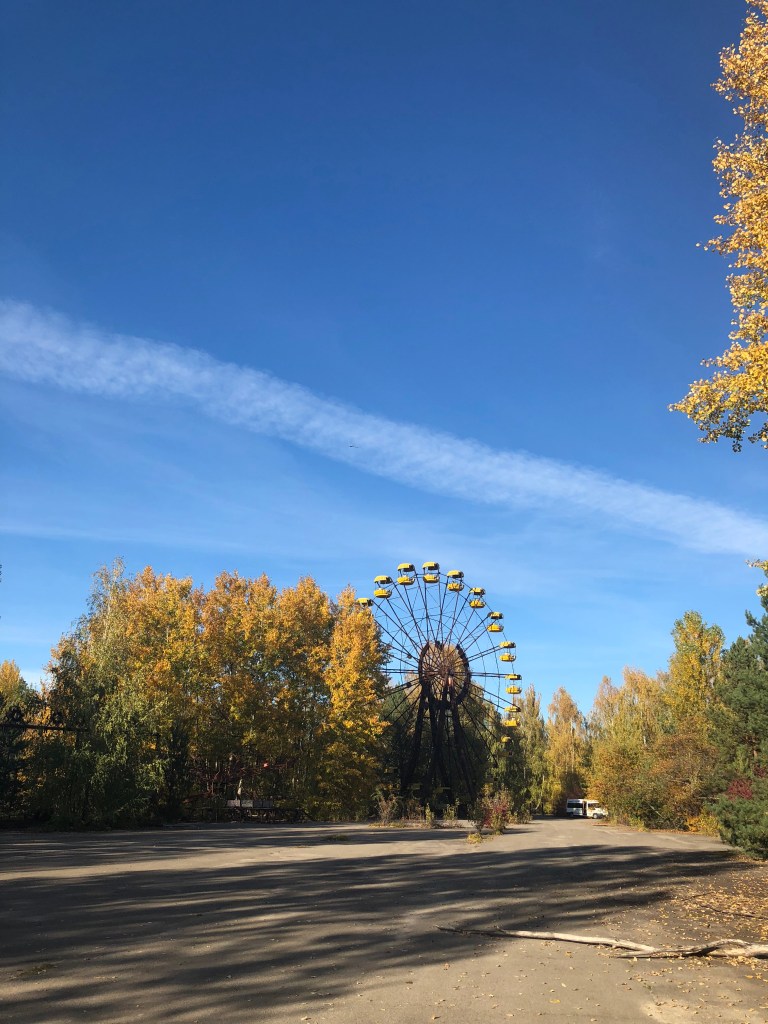
Amusement parks are usually places where you go with your family and friends to laugh and have fun. That is why the one in Pripyat seemed to me so eerie and out of place. Although, it was never opened (it was supposed to have its grand opening on 1st May, 1986), it became one of the symbols of the Chernobyl disaster. I believe everyone has seen the the iconic Ferris wheel on pictures as it is an especially popular landmark from the Exclusion Zone. But there are other attractions left to rot there – bumper cars, for example, or a carrousel that moved in an extremely creepy way every time there was wind.
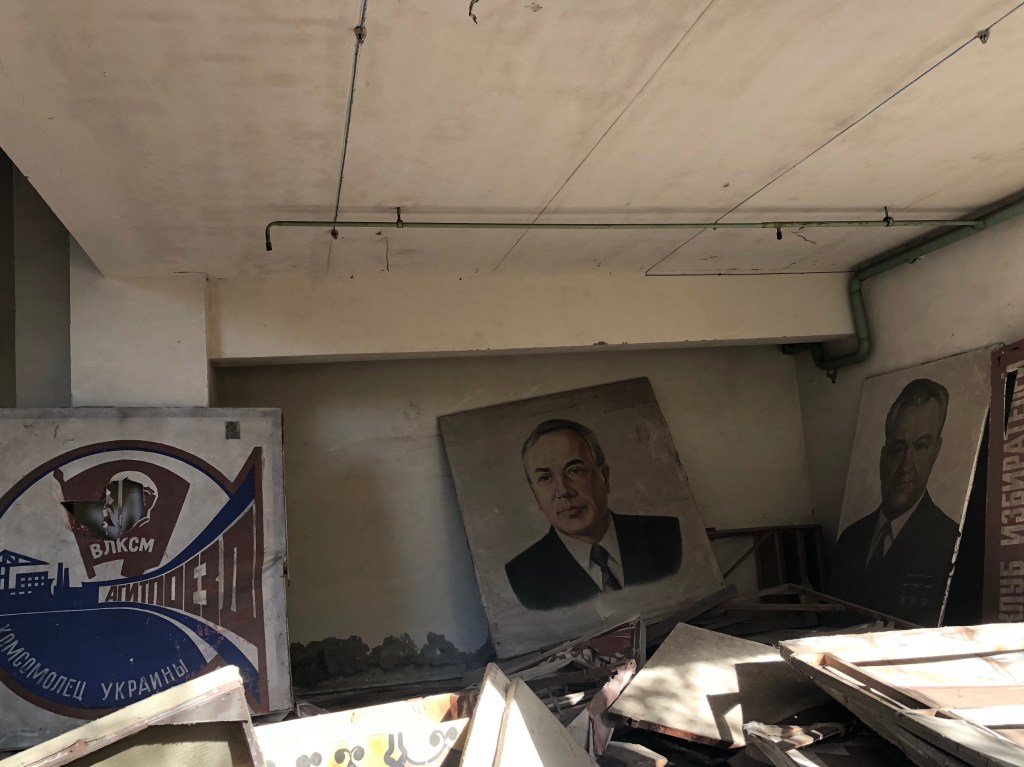
Other things you would be able to see if you visit Pripyat, are the abandoned hotel, the municipality building, the supermarket. I was impressed to see that in a room in the Municipality there were some huge placards, representing the communist leaders of the time. They were supposed to be used for the manifestation on 1st May that never happened as the city was evacuated a few days earlier. They stood there completely untouched, waiting to be picked up and brought to the celebration, as if time has stopped on the day of the accident.

In the rubbles of the supermarket, the outlines of a shopping cart could have been distinguished. We were explained that Pripyat was the only city in the whole Soviet Union, where shopping carts were available as there was no deficiency of products like everywhere else at the time. I remember my grandmother telling me stories how you had to wait on a queue for hours at a time in order to get your hands on products like bananas or sweets. Not in Pripyat, though – because of the nature of the work the employees of the power plant were doing, they were supplied with every king of goods they might have needed or wished.
Next location was the sports’ center. Here, we were allowed to enter and even climbed the stairs. For 30 years the destruction definitely took a tool on the place. The floor had caved in in places and everyone should have been very careful not to fall through it. We were shown the swimming pool, now completely empty. Somebody had made extra effort to make the place even creepier by moving the hands of the wall clock on the exact time of the accident.

We also visited the school. I would have never guessed what this was supposed to be if I was not told. Every piece of furniture was tipped over or smashed. It was hard to recognize what is what in that mess. Except in one room…Because the entire floor was covered with tiny gas masks. Apparently, they were removed from their storage by looters in search of small amounts of silver within their filters. Here, I should mention that the children have never worn the masks as the extent of the disaster was kept secret from the unsuspecting citizens.
Leaving the Zone
I will mention it again – I will never forget my visit to the Exclusion Zone. The day was long, exhausting and emotionally draining, although extremely interesting. When leaving the Zone, we passed with the bus by the Red Forest. Its name comes from the ginger-brown color of the pine trees, which they acquired after dying of radiation poisoning. This was the only place where our dosimeters were beeping the entire time, even though we were in the bus.
When exiting both the 10-kilometer and the 30-kilometer Zones, we were checked for radiation by human-size dosimeter machines. If radiation was discovered on any of our belongings, they should have been left behind.
For my surprise, right after we passed the machines, there was a small gift shop with souvenirs to remember the experience by. I got some presents for some more adventurous friends and a magnet for my fridge. Here, I learned about Simeon the fox, whose picture was on many of the souvenirs. The fox turned out to be a favorite of the visitors after he appeared on a BBC production about the Zone. He is famous for begging for food from the tourists and being exceptionally friendly with them. So if you decide to go, do not forget to bring something tasty in case you meet him.
If I have to describe my experience in Chernobyl with only one word, it would be eerie. Although the nature surrounding the place is extremely beautiful, there is something lingering in the air, some feeling I cannot describe. I am not superstitious, but I was not comfortable to be in any pictures from there. I did not want my photograph taken in a place, connected with so much suffering.
At last, one advice from me – if you want to visit the Zone, do it as soon as possible. The nature has reclaimed most of its territory, the buildings are falling apart, and soon everything that would be left to visit, is the ghost of immense human tragedy.
Photos: Personal Archive
 Confusion in Wonderland
[…] Part 3: The Chernobyl Nuclear Power Plant and The City of Pripyat (link here). […]
LikeLike
[…] Story continues here… […]
LikeLike